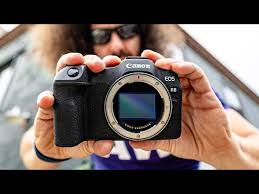
Canon EOS R8 Review: The Affordable Full-Frame Mirrorless Option for 2026
 shotinspect
Introduction
Canon continues to expand its EOS R lineup with the EOS R8, designed to provide full-frame image quality at a more accessible price point. Released in 2026, the R8 aims to attract enthusiasts and entry-level professionals who want the advantages of a full-frame mirrorless system without the high cost of top-tier models like the R6 Mark II. In this review, we’ll examine the camera’s design, performance, and value proposition for photographers in the U.S. and beyond.
Design and Build Quality
The Canon EOS R8 features a compact, lightweight body, weighing just 414 grams (body only). It retains Canon’s ergonomic design, making it comfortable for extended shoots, and the grip provides secure handling for both small and large hands. While the body lacks the extensive weather sealing of higher-end models, it is robust enough for general outdoor use.
The rear LCD is fully articulating and supports touch controls for focus selection, menu navigation, and image review. The electronic viewfinder (EVF) offers 2.36 million-dot resolution, providing a clear and bright view for composing images, though slightly less detailed than Canon’s higher-end models.
Sensor and Image Quality
The R8 features a 24.2-megapixel full-frame CMOS sensor paired with Canon’s DIGIC X image processor. This combination delivers excellent image quality with natural colors, accurate skin tones, and wide dynamic range.
Low-light performance is strong for its class, with a native ISO range of 100–102400, expandable to 50–204800. Noise control is impressive, ensuring clean images even in dimly lit environments such as indoor events or evening landscapes. Dynamic range allows for significant post-processing flexibility.
Autofocus and Speed
Canon’s Dual Pixel CMOS AF II system is present in the R8, offering 1053 selectable autofocus points and real-time tracking. Eye, face, and animal detection are reliable, making the camera versatile for portraiture, street photography, and wildlife.
Continuous shooting reaches up to 12 frames per second (fps) with the mechanical shutter, and 20 fps with the electronic shutter. While not as fast as the R6 Mark II in burst performance, it is sufficient for most hobbyists and semi-professional users.
Video Capabilities
The EOS R8 supports 4K video recording at 60fps with 10-bit 4:2:2 internal recording, making it an attractive option for content creators and vloggers. Full HD recording supports 120fps for smooth slow-motion capture. Canon Log and HDR PQ compatibility allow color grading and post-processing flexibility.
Unlike higher-end R-series models, the R8 does not include in-body image stabilization (IBIS), which may be a limitation for handheld video work. However, lens-based stabilization can partially compensate for this.
Connectivity and Workflow
The camera features dual card slots (SD UHS-II compatible) and Wi-Fi/Bluetooth connectivity for easy image transfer, remote control, and tethering. Canon’s Camera Connect app allows photographers to control the camera remotely, making it practical for studio, macro, and wildlife photography setups.
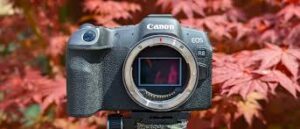
Pros
- Affordable full-frame mirrorless camera
- Excellent image quality with natural colors and skin tones
- Reliable Dual Pixel CMOS AF II system
- 4K video recording with 10-bit 4:2:2 internal support
- Compact and lightweight design
Cons
- Lacks in-body image stabilization (IBIS)
- EVF resolution lower than higher-end models
- Weather sealing is limited
Comparison with Competitors
Compared to the Sony A7C and Nikon Z5, the Canon EOS R8 offers competitive image quality and autofocus performance. While the Sony A7C is slightly more compact, Canon’s color science is preferred by many photographers for portraiture and lifestyle imagery. Nikon Z5 offers good dynamic range but lacks the video features and autofocus sophistication of the R8.
Conclusion
The Canon EOS R8 is an excellent entry-level full-frame mirrorless camera for 2026. It provides high-quality images, reliable autofocus, and robust video capabilities at a more accessible price.
For U.S. photographers and content creators seeking full-frame quality without breaking the bank, the EOS R8 offers a compelling balance of performance, portability, and value. Its versatility ensures it can handle portraits, street photography, landscapes, and video projects with confidence.
SEO Keywords Naturally Included: Canon EOS R8, full-frame mirrorless camera, 2026 camera review, best entry-level mirrorless camera, affordable full-frame camera, photography gear USA, 4K video camera, Canon camera review